What is healthcare advertising?
Healthcare advertising is paid promotion of a health service, product or provider, bought by everyone from a solo practice to a drugmaker: a search ad for a local clinic, a hospital billboard, a national TV spot for a prescription drug. For a private practice it mostly means search ads, shown to people already looking for the service.
It is one part of healthcare marketing, which also covers unpaid work such as search rankings, reviews and referrals; in the 5 P's of healthcare marketing, advertising sits under promotion. You will also see it called medical advertising or health advertising. The three terms overlap almost completely. What changes the rules is who is advertising, and to whom.
Healthcare advertising examples at a glance:
- a search ad for a local clinic, shown to someone searching "concierge doctor near me";
- a hospital or health system brand campaign on TV, radio and billboards;
- a public health campaign, such as the CDC's Tips From Former Smokers;
- a disease-awareness campaign, such as Novartis's 2025 Super Bowl ad for breast cancer screening;
- a drugmaker's TV ad for a prescription drug, which carries the FDA's "major statement" of risks;
- a social ad for a therapy practice or telehealth service;
- a paid directory listing.
Each is covered below, with real campaigns and annotated example ads.
Types of healthcare advertising
This guide groups healthcare advertising into eight main channels. Here is who typically buys each one, what it is good for, and the rule that shapes it most.
| Channel | Who typically buys it | Good for | The main rule |
|---|---|---|---|
| Search ads | Practices, telehealth companies, hospitals | People searching for a service right now | Google: no audiences built from health interests or your own lists; certification for prescription drug services and addiction treatment |
| Social ads | Practices, health systems, telehealth and consumer health brands | Reaching people before they search | Meta: no copy that implies you know the reader's health, and no health-cause targeting since January 2022 |
| Display and programmatic | Hospitals, drugmakers, telehealth brands | Broad reach on websites and apps | Google's health policies also bind Display & Video 360 buyers; no remarketing lists for health ads |
| Video and connected TV | Health systems, drugmakers, telehealth brands | Awareness with sight and sound | The platform's health policy, plus FDA rules when a drugmaker's ad names a prescription drug |
| TV, radio and billboards | Hospitals and health systems, health plans, drugmakers, public health agencies | Broad awareness across a region | FTC: health claims need scientific evidence; FDA's "major statement" rule for prescription drug TV and radio ads |
| Print and direct mail | Hospitals, practices, drugmakers (including medical journals) | A defined area, or clinicians through journals | FTC: claims need evidence; a drugmaker's printed prescription drug ad carries a brief summary of side effects and effectiveness |
| Directories | Practices and individual clinicians | Being found where patients compare providers | Your licensing board's advertising rules apply to a paid listing like any other ad |
| Direct-to-consumer prescription drug ads | Drugmakers | Getting patients to ask a clinician about a drug | FDA (21 CFR 202.1): risk information in product ads; on TV, the major statement in audio and text at once |
For most private practices, the rows that matter are search, directories such as Psychology Today, and some social. The rest is mostly where hospital, pharma and telehealth budgets go.
Who are healthcare advertisers?
Healthcare advertisers are not one group. A private practice promoting appointments, a hospital system, a telehealth company, a drugmaker and an online pharmacy all advertise health, and each answers to a different mix of platform policies, regulators and professional boards.
- Private practices and clinics. Google and Meta ad policies, the FTC on claims, and their state licensing board's advertising rules. Most practice services need no special certification.
- Hospitals and health systems. The same platform and FTC rules, plus HIPAA wherever ad tracking touches patient information on their websites. Many also buy TV, radio and billboards, like the Kaiser Permanente campaign below.
- Telehealth companies. To advertise prescribing services on Google in the US, a telemedicine provider needs LegitScript certification as well as Google's own healthcare certification (Google's healthcare and medicines policy).
- Drugmakers. The FDA regulates prescription drug advertising, and its Office of Prescription Drug Promotion reviews ads and promotional labeling to make sure they are not false or misleading. Google also requires pharmaceutical manufacturers to be certified before their ads run.
- Pharmacies. In the US, an online pharmacy needs LegitScript certification or NABP accreditation, plus Google's certification, before Google will run its ads.
- Health insurers. In the US, Google requires certification to advertise health insurance; government advertisers such as state exchanges go through Google's own process.
- Makers of supplements, over-the-counter drugs and other health products. The FTC has primary responsibility for advertising claims about these products, according to its Health Products Compliance Guidance.
- Public health agencies. The CDC and FDA run their own campaigns, two of which are below.
Most of these advertisers work with an agency built for their kind of buyer; our guide to healthcare advertising and marketing agencies sorts the best-known firms by who they serve. This guide is written for practices. From here on, it is about practices advertising to patients, with the bigger advertisers as examples.
Healthcare advertising examples
Four real public campaigns, one rule that shapes every prescription drug TV ad, illustrative ads for practices (a search ad, a social ad and a billboard), and an annotated mockup. The real campaigns are described and linked rather than reproduced.
Real campaigns
CDC: Tips From Former Smokers. The CDC launched Tips From Former Smokers in March 2012, describing it as the first-ever federally funded national tobacco education campaign. Its ads profile real people affected by serious long-term health effects of smoking and secondhand smoke, and the campaign points people to free quit help at 1-800-QUIT-NOW. What a practice can take from it: one clear next step, and the step is free. What a practice can't copy: the stories themselves. In a practice ad, a patient's own story is a testimonial, which many professional codes restrict and which the FTC treats as no substitute for evidence.
FDA: The Real Cost. The FDA's youth tobacco prevention campaign, The Real Cost, marked its 10th anniversary in 2024. It teaches teenagers about the health effects and risks of vaping and smoking, on the channels teenagers use. To judge the e-cigarette campaign, researchers measure teens' awareness of the ads, their knowledge, attitudes and beliefs about e-cigarettes, and whether they start using them. The lesson for a practice: one audience, one message, and a measure chosen before the campaign starts.
Kaiser Permanente: Thrive. For the 2017 open enrollment season, Kaiser Permanente announced a Thrive campaign of at least four TV spots plus radio, online and out-of-home ads, with English and Spanish versions of the TV ads running through January 2018. One spot, "Tireless", featured two of its own specialists from the Mid-Atlantic region (Kaiser Permanente's announcement). That is health-system advertising in miniature: a season of broad reach across many channels, with one spot built around the system's own clinicians rather than patients' results.
Novartis: Your Attention, Please. Novartis announced the campaign on 28 January 2025, with its first-ever commercial airing during Super Bowl LIX on FOX on 9 February. Its stated aim is to raise breast cancer screening rates. Wanda Sykes and Hailee Steinfeld appear alongside national and local breast cancer advocacy groups, and the centerpiece is a website, YourAttentionPlease.com, where women can learn about their risk and schedule routine screenings if they are eligible. It is a disease-awareness campaign: the action it asks for is a screening. The lesson for a practice: one action, and a page built to make that action easy.
A prescription drug TV ad, explained through the rule it follows. A drugmaker's TV or radio ad that names a prescription drug and what it treats must state the drug's major side effects and contraindications, known as the "major statement", and either include a brief summary of all the necessary risk information or make "adequate provision" for viewers to get the full approved labeling (21 CFR 202.1). Under an FDA final rule that took effect on 20 May 2024, with compliance required from 20 November 2024, the major statement must be clear, conspicuous and neutral. On TV that means consumer-friendly language, audio and on-screen text at the same time, audio at least as understandable as the rest of the ad, and no sounds or images that get in the way. That is why the risk section of a TV drug ad sounds and looks the way it does.
Illustrative practice ads
Three ads for fictional practices, written the way we would write them. The practices are invented; the rules they follow are real.
Search ad: concierge medicine
Concierge Medicine in Raleigh | Annual Fee Listed
Longer visits and a direct line to your doctor. See the annual fee, then book a call.
A service plus a place in the headline, and the payment model in plain sight, which Google's misrepresentation policy expects. The next step is a call, not a promise about anyone's health.
Search ad: GI screening
Self-Pay Colonoscopy in Tampa | Price Listed Online
Board-certified gastroenterologists. See the all-in price and book a consult online.
What it leaves out matters as much. There is no question like "Having stomach trouble?", which implies knowledge of the reader's health, the line Meta's ad policy draws. And there is no claim about what the screening will find or prevent. A screening ad names the service, the price and the next step. Credentials in an ad have to be accurate, so "board-certified" only goes in if it is true of every doctor it describes.
Landing page headline: functional medicine
Functional medicine in Boulder, by membership.
Membership, lab and visit fees are on this page. Book a 20-minute intro call.
It repeats the ad, shows the cost and offers one way to book. What we would not write here: "Fix the root cause of your fatigue" or "Reverse your diagnosis". Those are health claims, and the FTC's standard for any health claim is competent and reliable scientific evidence.
Illustrative mockup: social ad
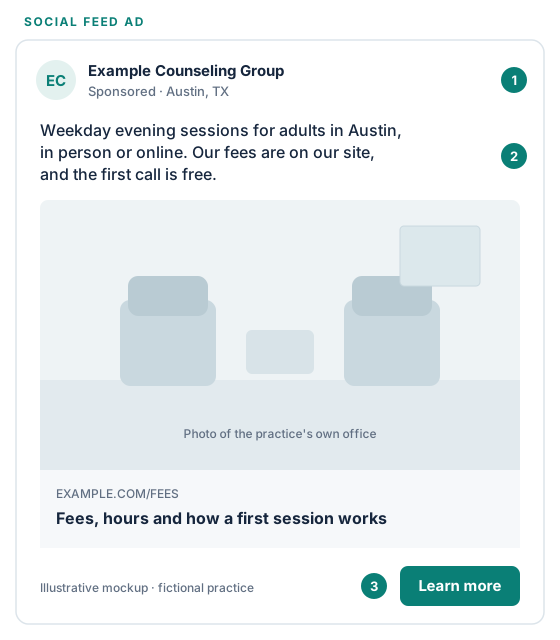
- Targeted by place and age, with no detailed targeting by health causes, which Meta removed in January 2022.
- The copy names the service, not the reader's condition. No "Struggling with anxiety?"
- The click goes to a page about fees and a first session, not straight to a booking form, because social reaches people before they are ready to book.
Illustrative mockup: billboard
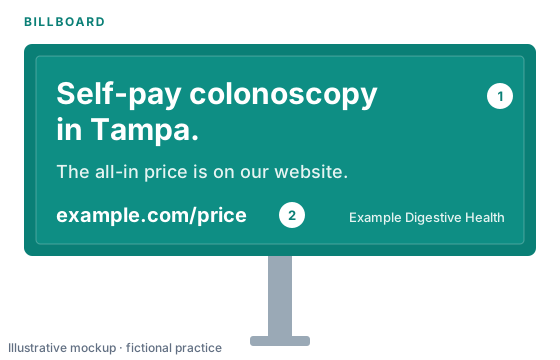
- One service and one place, readable at a glance.
- The price lives on the website the billboard names, so it can be kept current, and the board makes no claim about what screening will find or prevent.
What we would not write for any healthcare ad: a question about the reader's symptoms, a promised result, a before-and-after, or a patient's words used as a testimonial. Therapy practices will find ads written for therapy, and the reasons behind each line, in our guide to Google Ads for therapists.
Annotated: a search ad and the page it lands on
Here is the concierge ad above, next to the page it should land on. The numbers match the notes below the image.
Illustrative mockup
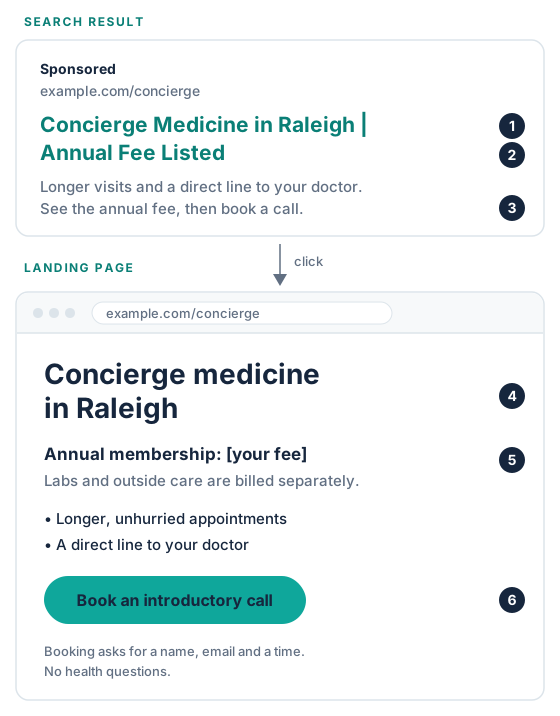
- Service and place in the headline, matching what the person searched.
- The payment model in the ad. Google's misrepresentation policy expects it to be disclosed clearly.
- A next step, not an outcome: a call, with nothing promised about anyone's health.
- The page repeats the ad: same service, same place, so nobody wonders if they clicked the wrong link.
- The fee is on the page, not behind a phone call. Show your own; the mockup leaves a placeholder on purpose.
- One way to book, and a booking form with no health questions, so ad tags on the page never see health details.
The rules that apply to every healthcare ad
- No targeting by health condition on Google. Google's personalized advertising policy treats health as a sensitive interest category, and advertisers promoting products or services in a sensitive interest category can't use audiences they curate themselves, such as remarketing lists or customer lists.
- No health-cause targeting on Meta. Meta removed detailed targeting options relating to health causes from 19 January 2022.
- Don't imply you know the reader's condition. Meta's personal attributes policy doesn't allow ads that imply knowledge of someone's medical information. Its own examples: "Depression counseling" is allowed; "Depression getting you down? Get help now." is not.
- Prescription drugs and some services are restricted. Google's healthcare and medicines policy restricts prescription drug terms in ads, landing pages and keywords. In the US, online pharmacies and prescribing telemedicine providers need third-party certification plus Google's own, and so do recovery-oriented drug and alcohol addiction services. Our guide to LegitScript certification covers who needs it and how it works.
- Claims need evidence. The FTC's health products compliance guidance says health claims need competent and reliable scientific evidence, and that individual experiences are never enough on their own.
- Show what people will pay. Google's misrepresentation policy doesn't allow ads that fail to clearly disclose the payment model or the full expense a user will bear.
Your professional board's advertising rules sit on top of all of these. Check them for testimonials, titles and credentials before anything runs.
Healthcare digital advertising
Healthcare digital advertising covers search ads, social ads, and display and video ads on websites, apps and streaming services. For a private practice they do different jobs. Search reaches people who are ready to book, social reaches them earlier, and display and video build familiarity in an area. None of them can target someone because of a health condition, and on Google a health advertiser can't use remarketing or customer lists either. For the unpaid side, such as search rankings, reviews and follow-up, see our guide to healthcare digital marketing.
Healthcare search engine marketing
Search engine marketing means paying to appear in search results, usually alongside the work of ranking organically. For a private practice it is the most direct form of healthcare advertising, because the person has already told you what they want.
- Keywords that mean "ready to book". A service plus a place or a need: "concierge doctor near me", "psychiatrist Denver", "self-pay colonoscopy Tampa". Broad terms attract researchers and students.
- Negative keywords from day one. "Free", "jobs", "salary", "course" and, if you're private-pay only, insurance terms.
- One landing page per service. The page should match the ad, show the fee and have one way to book.
- Paid and organic together. Search ads buy visibility this week; local SEO builds visibility that keeps working when the budget stops.
For a full campaign setup, see our guides to Google Ads for doctors and Google Ads for therapists.
Social ads without condition targeting
Social ads still work for many practices, but they reach people earlier, before they are ready to book. Target by location and broad interests, and let the copy do the filtering: name the service, the approach and who it's for, without implying the reader has a condition.
Send social traffic to something useful, like a page answering common questions or a clear explanation of fees, rather than straight to a booking form.
Landing pages and tracking
An ad is only as good as the page it lands on. The page should repeat the promise of the ad, show the price, and make booking one step, as in the mockup above.
Be careful with tracking. In June 2024 a federal court vacated part of HHS's guidance on online tracking technologies, and in August 2024 HHS withdrew its appeal, but HIPAA still applies to protected health information. Keep ad pixels off pages where people enter health details, and ask your compliance adviser about the rest. Our compliance page sets out how we keep patient information out of ad platforms.
Budgets and what to measure
Costs depend on your city, your specialty and how many practices bid on the same searches. Google's Keyword Planner shows estimated searches and costs for your main keywords, which is a better starting point than any average quoted online.
Judge every campaign on booked appointments and the cost of each one. Platforms learn from whatever you tell them to count, so count bookings, not clicks or form views. Our medical PPC page explains how we report on that every week, and the free patient acquisition cost calculator puts the cost of a new patient next to what that patient is worth.
Much of the money in healthcare advertising is lost after the click, not before it: an inquiry that waits a day for a reply, or a call nobody answers. Our guide to speed to lead covers that half.
If you would rather hand the work to someone, that is the job we do: Fill The Lobby is a healthcare marketing agency for cash-pay practices that runs the ads, fixes the page behind them, and reports on booked appointments.
Advertising to healthcare professionals
HCP advertising, or HCP marketing, is advertising aimed at clinicians rather than patients: a drug, device, lab or software company reaching doctors, nurses and therapists through medical journals, conferences, professional networks and sales teams. It is judged on prescriptions or adoption rather than appointments, and prescription drug ads aimed at clinicians fall under the same FDA regulation as consumer ads, so a journal ad for a prescription drug still carries a brief summary of side effects, contraindications and effectiveness (21 CFR 202.1). A practice sits on the other side of that relationship.
Sources
- Google Ads Help — Healthcare and medicines policy, checked 8 October 2026
- Google Ads Help — Restricted targeting in personalized advertising, checked 8 October 2026
- Google Ads Help — Misrepresentation policy, checked 8 October 2026
- Google Ads Help — Use Keyword Planner, checked 8 October 2026
- Meta — Removing certain ad targeting options and expanding our ad controls (9 November 2021), checked 8 October 2026
- Meta Transparency Center — Privacy violations and personal attributes, checked 8 October 2026
- FTC — Health Products Compliance Guidance (December 2022), checked 8 October 2026
- Novartis — "Early detection is a game changer" (media release, 28 January 2025), checked 12 October 2026
- eCFR — 21 CFR 202.1, Prescription-drug advertisements, checked 8 October 2026
- Federal Register — Direct-to-Consumer Prescription Drug Advertisements: Presentation of the Major Statement in a Clear, Conspicuous, and Neutral Manner (21 November 2023), checked 8 October 2026
- FDA — The Office of Prescription Drug Promotion (OPDP), checked 8 October 2026
- CDC — About the Tips From Former Smokers campaign, checked 8 October 2026
- FDA — The Real Cost campaign, checked 8 October 2026
- Kaiser Permanente KPproud Mid-Atlantic States — 2017 Thrive marketing campaign launches, checked 8 October 2026
- AHA News — Judge rules in favor of AHA vacating HHS online tracking bulletin (20 June 2024), checked 8 October 2026
- AHA News — HHS will not appeal AHA court victory in online tracking case (29 August 2024), checked 8 October 2026