A clinician's license stops at the state line, and so should their advertising. Licensure compacts let psychologists and counselors practice in other member states without a separate license in each, will soon do the same for social workers and physician assistants, and already speed up extra licenses for physicians. Which states are in which compact decides where a telehealth practice can take new clients, and so where its ads should run.
This guide lists the members of each compact, with the date we last checked each one against the compact's own site, and ends with what it means for your marketing. Membership changes every legislative session, so check the official maps linked under Sources before you rely on it. Your own state's page under healthcare marketing rules by state has the same compact status alongside its licensing boards' advertising rules, its privacy law and patient search data for its cities.
Which states are in PSYPACT in 2026?
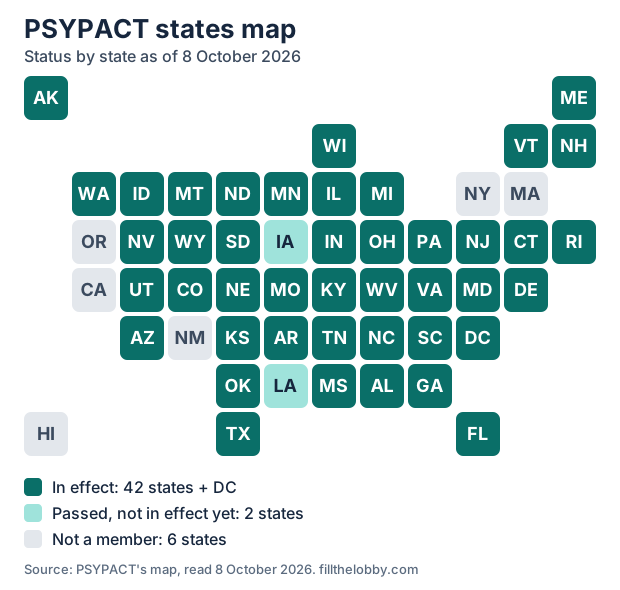
PSYPACT was in effect in 42 states and the District of Columbia when we last read PSYPACT's map, on 8 October 2026. Another 2 states have passed it, but it isn't in effect there yet, and 6 states are not members.
| PSYPACT status on 8 October 2026 | States |
|---|---|
| In effect: 42 states and DC | Alabama, Alaska, Arizona, Arkansas, Colorado, Connecticut, Delaware, Florida, Georgia, Idaho, Illinois, Indiana, Kansas, Kentucky, Maine, Maryland, Michigan, Minnesota, Mississippi, Missouri, Montana, Nebraska, Nevada, New Hampshire, New Jersey, North Carolina, North Dakota, Ohio, Oklahoma, Pennsylvania, Rhode Island, South Carolina, South Dakota, Tennessee, Texas, Utah, Vermont, Virginia, Washington, West Virginia, Wisconsin and Wyoming, plus the District of Columbia |
| Passed, not in effect yet: 2 states | Iowa (from 1 July 2027) and Louisiana (from 1 January 2028) |
| Not members: 6 states | California, Hawaii, Massachusetts, New Mexico, New York and Oregon |
Alaska is the newest; its membership took effect on 20 September 2026. Louisiana's law, Act 302 of 2026, takes effect on 1 January 2028, and until then its psychology board says psychologists can't use PSYPACT to practice into or out of Louisiana. New Mexico's House passed a PSYPACT bill, HB 33, 64 to 0 in February 2026, but it died in the Senate.
What is PSYPACT?
PSYPACT, the Psychology Interjurisdictional Compact, is an interstate compact: a law each member state enacts, which lets a psychologist licensed in one member state practice in the others without another license. It covers telepsychology and temporary in-person practice. It doesn't apply to permanent in-person practice, or when a psychologist is licensed in both states (see, for example, Iowa's 2026 enactment).
The PSYPACT Commission governs the compact and grants the two authorizations below, as the Virginia Board of Psychology explains. The compact sets the Commission up as a joint public agency of the member states, with one commissioner appointed by each state's psychology regulator. Each authorization first needs a credential from ASPPB, the Association of State and Provincial Psychology Boards.
APIT and TAP: the two PSYPACT authorizations
| Detail | APIT: telehealth | TAP: temporary in-person |
|---|---|---|
| Full name | Authority to Practice Interjurisdictional Telepsychology | Temporary Authorization to Practice |
| What it allows | Telepsychology with clients who are physically in another PSYPACT state | In-person, face-to-face practice in another PSYPACT state for up to 30 days within a calendar year, after notifying that state |
| Where the psychologist is | In their home state, a PSYPACT state where they hold a full, unrestricted license | Physically in the other state |
| Whose rules apply | The scope of practice of the state where the client is | The scope of practice, authority and law of the state where the psychologist is working |
| ASPPB credential needed | E.Passport: $400 to apply, $100 a year to renew | Interjurisdictional Practice Certificate (IPC): $200 to apply, $50 a year to renew |
| PSYPACT Commission fee | $40 to apply, $40 a year to renew | $40 to apply, $40 a year to renew |
The scope and time limits are in the compact's text. ASPPB's fee schedule lists the E.Passport at $400 to apply and $100 a year to renew, and the IPC at $200 to apply and $50 a year to renew.
ASPPB collects the Commission's fee along with its own. Its E.Passport FAQs say you pay $440 in total to apply for the E.Passport, including the APIT processing fee, and $140 to renew it, including the APIT renewal fee. For the IPC you pay $240, including the TAP processing fee. The $40 yearly TAP renewal is as New Mexico's Regulation and Licensing Department listed it in its January 2026 bill analysis. Fees change, so check ASPPB and the PSYPACT Commission before you apply.
How to get PSYPACT authorization
- Hold a full, unrestricted license in a PSYPACT state. That is your home state. ASPPB's quick guides for the E.Passport and the IPC also require the license to be based on a doctoral degree in psychology, with no disciplinary action listed on any license.
- Get the ASPPB credential: the E.Passport for telehealth, or the IPC for in-person work. ASPPB needs official doctoral transcripts sent directly from your university or its clearinghouse, and a score at or above ASPPB's recommended passing score on the Examination for Professional Practice in Psychology (EPPP). Its policies list some exceptions, for example for psychologists continuously licensed since before 1985, and also require three hours of training in the use of technology in psychology for the E.Passport. ASPPB says processing takes 2 to 3 weeks.
- Apply to the PSYPACT Commission for the APIT or TAP, with attestations about your intended practice and a release that lets your details be verified. Florida's board, for example, says state boards aren't involved in processing PSYPACT applications, and tells psychologists to apply directly to PSYPACT.
- Renew both every year. E.Passport holders also need three hours of continuing education on technology in psychology each year.
Two conditions in ASPPB's own steps matter for marketing: the psychologist must be licensed and physically present in their home state when they deliver telepsychology, and each client must be physically present in a PSYPACT state. A psychologist licensed in California, New York or another non-member state can't use PSYPACT from there, and a client located in a non-member state can't be seen under it.
PSYPACT and licensure compact map: all 50 states and DC
Every state and DC, with its status in five compacts. The PSYPACT column is as of our last read on 8 October 2026; the Counseling Compact, Social Work Compact, IMLC and PA Compact columns were checked against each compact's own site on 8 October 2026. “Issuing privileges” means counselors can already use the Counseling Compact there. For the IMLC, “Member, can't be home state” means the state issues licenses through the compact but a physician can't use it as their state of principal license, and “Passed, not live yet” means the compact lists its implementation as in process or delayed. No state is issuing PA Compact privileges yet. Each state name links to its page.
| State | PSYPACT | Counseling Compact | Social Work Compact | IMLC (physicians) | PA Compact |
|---|---|---|---|---|---|
| Alabama | In effect | Member, not live yet | Enacted | Member | Member |
| Alaska | In effect | No | Enacted | Passed, not live yet | Member |
| Arizona | In effect | Issuing privileges | Enacted | Member | Member |
| Arkansas | In effect | Issuing privileges | Enacted | Member | Member |
| California | No | No | No | No | No |
| Colorado | In effect | Member, not live yet | Enacted | Member | Member |
| Connecticut | In effect | Member, not live yet | Enacted | Member | Member |
| Delaware | In effect | Member, not live yet | Enacted | Member | Member |
| Florida | In effect | Member, not live yet | No | Member | No |
| Georgia | In effect | Issuing privileges | Enacted | Member | No |
| Hawaii | No | No | No | Member, can't be home state | No |
| Idaho | In effect | No | No | Member | No |
| Illinois | In effect | No | No | Member | No |
| Indiana | In effect | Issuing privileges | No | Member | No |
| Iowa | Passed, not in effect yet | Member, not live yet | Enacted | Member | Member |
| Kansas | In effect | Member, not live yet | Enacted | Member | Member |
| Kentucky | In effect | Member, not live yet | Enacted | Member | No |
| Louisiana | Passed, not in effect yet | Issuing privileges | Enacted | Member | No |
| Maine | In effect | Member, not live yet | Enacted | Member | Member |
| Maryland | In effect | Member, not live yet | Enacted | Member | No |
| Massachusetts | No | No | No | No | No |
| Michigan | In effect | No | No | Member | Member |
| Minnesota | In effect | Issuing privileges | Enacted | Member | Member |
| Mississippi | In effect | Member, not live yet | Enacted | Member | No |
| Missouri | In effect | Member, not live yet | Enacted | Member | Member |
| Montana | In effect | Member, not live yet | No | Member | Member |
| Nebraska | In effect | Member, not live yet | Enacted | Member | Member |
| Nevada | In effect | Member, not live yet | No | Member | No |
| New Hampshire | In effect | Member, not live yet | Enacted | Member | Member |
| New Jersey | In effect | Member, not live yet | Enacted | Member | Member |
| New Mexico | No | No | Enacted, with material changes | Passed, not live yet | No |
| New York | No | No | No | No | No |
| North Carolina | In effect | Member, not live yet | Enacted | Member | Member |
| North Dakota | In effect | Member, not live yet | Enacted | Member | Member |
| Ohio | In effect | Issuing privileges | Enacted | Member | Member |
| Oklahoma | In effect | Issuing privileges | Enacted | Member | Member |
| Oregon | No | No | No | No | No |
| Pennsylvania | In effect | Member, not live yet | No | Member | No |
| Rhode Island | In effect | Member, not live yet | Enacted | Passed, not live yet | Member |
| South Carolina | In effect | Member, not live yet | Enacted, with material changes | No | No |
| South Dakota | In effect | Member, not live yet | Enacted | Member | Member |
| Tennessee | In effect | Issuing privileges | Enacted | Member | Member |
| Texas | In effect | No | No | Member | No |
| Utah | In effect | Member, not live yet | Enacted | Member | Member |
| Vermont | In effect | Member, not live yet | Enacted | Member, can't be home state | No |
| Virginia | In effect | Member, not live yet | Enacted | No | Member |
| Washington | In effect | Member, not live yet | Enacted | Member | Member |
| Washington, DC | In effect | Member, not live yet | No | Member | No |
| West Virginia | In effect | Member, not live yet | Enacted | Member | Member |
| Wisconsin | In effect | Member, not live yet | Enacted | Member | Member |
| Wyoming | In effect | Issuing privileges | No | Member | No |
Which states are in the Counseling Compact?
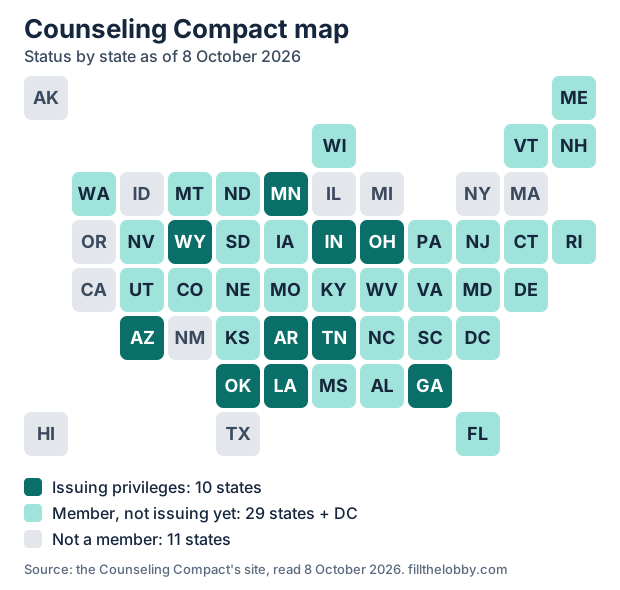
The Counseling Compact has 40 members, 39 states and the District of Columbia, and it is issuing privileges to practice in 10 of them, as of our check of the compact's own site on 8 October 2026.
| Counseling Compact status on 8 October 2026 | States |
|---|---|
| Members: 39 states and DC | Alabama, Arizona, Arkansas, Colorado, Connecticut, Delaware, Florida, Georgia, Indiana, Iowa, Kansas, Kentucky, Louisiana, Maine, Maryland, Minnesota, Mississippi, Missouri, Montana, Nebraska, Nevada, New Hampshire, New Jersey, North Carolina, North Dakota, Ohio, Oklahoma, Pennsylvania, Rhode Island, South Carolina, South Dakota, Tennessee, Utah, Vermont, Virginia, Washington, West Virginia, Wisconsin and Wyoming, plus the District of Columbia |
| Issuing privileges now: 10 states | Arizona, Arkansas, Georgia, Indiana, Louisiana, Minnesota, Ohio, Oklahoma, Tennessee and Wyoming |
| Not members: 11 states | Alaska, California, Hawaii, Idaho, Illinois, Massachusetts, Michigan, New Mexico, New York, Oregon and Texas |
Pennsylvania became the 40th member when Governor Josh Shapiro signed it on 12 July 2026.
Is the Counseling Compact live?
In ten states, listed in the table above. The compact began issuing privileges to practice on 30 September 2025 in Arizona and Minnesota, and Oklahoma became the tenth state on 1 October 2026. The other members have passed the law and are still completing the technical and regulatory steps. A counselor who is licensed in, and lives in, a live home state can apply for a privilege to practice in the other live states instead of a separate license in each.
Which licenses it covers: LPC, LMHC, LPCC and LCPC
States give the counseling license different names. Arizona licenses LPCs, Minnesota and Ohio license LPCCs, Florida licenses LMHCs, and Illinois uses LCPC for its clinical license. The compact covers the license by what it allows, not by its title. Its model law defines a licensed professional counselor as “a counselor licensed by a Member State, regardless of the title used by that State, to independently assess, diagnose, and treat behavioral health conditions.” So an LMHC is covered where LMHC is the state's independent counseling license, and a license that only allows practice under supervision doesn't fit the definition.
It isn't reciprocity or licensure by endorsement either: you don't get a second license. You keep your home-state license, where your home state is your primary state of residence, and add a privilege to practice in each other live state, which the compact defines as “a legal authorization, which is equivalent to a license”.
Is there a licensure compact for marriage and family therapists?
Not one in operation that we could find. The Counseling Compact is written for the professional counselor license, so a marriage and family therapist (LMFT) license isn't the route into it. The profession's association, AAMFT, is pursuing a different approach it calls Access MFTs: state laws that let an MFT with a valid, unrestricted license in another state get a full license by endorsement, without having to prove their training is “substantially equivalent”. By June 2026, AAMFT counted 17 states that had passed its enhanced portability legislation since 2024, with Minnesota and Rhode Island among the 2026 additions; Minnesota's law took effect on 1 August 2026.
That is still one license per state, applied for one at a time, so an MFT practice should target ads only to the states where each therapist already holds a license.
Which states are in the Social Work Licensure Compact?
The Social Work Licensure Compact is enacted in 35 states: Alabama, Alaska, Arizona, Arkansas, Colorado, Connecticut, Delaware, Georgia, Iowa, Kansas, Kentucky, Louisiana, Maine, Maryland, Minnesota, Mississippi, Missouri, Nebraska, New Hampshire, New Jersey, New Mexico, North Carolina, North Dakota, Ohio, Oklahoma, Rhode Island, South Carolina, South Dakota, Tennessee, Utah, Vermont, Virginia, Washington, West Virginia and Wisconsin. The compact's own map marks New Mexico and South Carolina as enacted “with material changes” to the model language, and the compact warns that substantive changes may jeopardize a state's participation.
It isn't issuing multistate licenses yet. In July 2026 the compact said its data system was being built, with completion estimated for spring 2027, and that the whole implementation takes about 18 to 24 months before social workers can apply. Until then, a clinical social worker still needs a license in each state where their clients are.
Which states are in the IMLC?
The Interstate Medical Licensure Compact works differently from the others. It doesn't create a privilege to practice; it is a faster path to a full license in each member state, still issued by that state's own board. The compact describes itself as including 44 states, the District of Columbia and Guam. Its map on 14 October 2026 showed:
- Issuing licenses, 41 states plus DC and Guam: Alabama, Arizona, Arkansas, Colorado, Connecticut, Delaware, Florida, Georgia, Hawaii, Idaho, Illinois, Indiana, Iowa, Kansas, Kentucky, Louisiana, Maine, Maryland, Michigan, Minnesota, Mississippi, Missouri, Montana, Nebraska, Nevada, New Hampshire, New Jersey, North Carolina, North Dakota, Ohio, Oklahoma, Pennsylvania, South Dakota, Tennessee, Texas, Utah, Vermont, Washington, West Virginia, Wisconsin and Wyoming. Hawaii and Vermont issue licenses through the compact but can't serve as a physician's state of principal license.
- Passed, implementation in process or delayed: Alaska, New Mexico and Rhode Island.
- Not members: California, Massachusetts, New York, Oregon, South Carolina and Virginia. New York has legislation introduced.
A psychiatrist offering telepsychiatry still holds a license in every state where their patients are; the IMLC only makes getting those licenses faster. So for psychiatry practice marketing, each psychiatrist's license list, not the compact map, sets where the ads can run.
Compacts for nurse practitioners and PAs
Physician assistants. The PA Licensure Compact has 29 member states: Alabama, Alaska, Arizona, Arkansas, Colorado, Connecticut, Delaware, Iowa, Kansas, Maine, Michigan, Minnesota, Missouri, Montana, Nebraska, New Hampshire, New Jersey, North Carolina, North Dakota, Ohio, Oklahoma, Rhode Island, South Dakota, Tennessee, Utah, Virginia, Washington, West Virginia and Wisconsin. No state is issuing compact privileges yet; the compact projects that they will be available in early 2027. Until then, a PA needs a license in each state where their patients are.
Nurse practitioners. NCSBN's compact pages still describe an APRN compact in the future tense (it “will increase access to care”) and list no member states, so a psychiatric nurse practitioner seeing patients across state lines must meet the requirements of the state where each patient is located, as NCSBN's own APRN guidance puts it. For a psychiatry practice that staffs NPs or PAs, ad targeting follows each prescriber's own licenses.
What the compacts mean for telehealth marketing
For telehealth, the practice generally counts as happening where the client is at the time of the session. The Counseling Compact's model law says so in its first section, and ASPPB applies the same test under PSYPACT. That turns licensure into an advertising rule:
- Target ads by state, not by radius. Set Google and Meta location targeting to the states where each clinician can legally see clients. In Google Ads, use the “Presence” option, which reaches people in or regularly in those states, rather than the default, which also reaches people who have only shown interest in them.
- Say where you practice, in plain text. “Online therapy for adults anywhere in Colorado, Utah and Arizona” on the booking page and in your directory profiles saves an intake call with someone you can't see.
- Update the map when your authorizations change. An APIT or a new counseling privilege adds states; add them to the targeting and the page the same week, and not before it's granted.
- Check the client's state at booking. Asking where the client will be during sessions is a location question, not a health question, and it catches the out-of-state traveler before the first session.
- Group practices: map each clinician. One clinician may be licensed in three states and another in one. Booking should only offer each clinician's openings to clients in the states they can serve.
Online therapy in PSYPACT states
For a psychologist offering online therapy under PSYPACT, what counts is where the client physically is during the session, not where they live. ASPPB tells APIT holders to follow the scope of practice of the state where each client is physically present, and that state must be in PSYPACT. So a landing page should say it in those words, for example “Online sessions for adults located in a PSYPACT state at the time of the session”, followed by the list of states, and the intake form should ask where the client will be for each session. Google's Presence option reaches people who are regularly in a state as well as people there now, so the targeting narrows the audience, but the question at booking is what confirms it.
This is the setup we run for telehealth practices. The state pages add each state's patient searches and click costs, so you can see where the demand is before you choose where to be licensed or authorized next, and our guide to how to start a private practice covers the rest of that decision.
Sources
- PSYPACT, compact map, checked 8 October 2026
- Louisiana State Board of Examiners of Psychologists — PSYPACT, checked 12 October 2026
- Louisiana Legislature — HB 486 (2026 Regular Session), Act 302, checked 12 October 2026
- Iowa Legislature — House File 2676 (2026), enrolled, Division XI: Psychology Interjurisdictional Compact (PDF), checked 12 October 2026
- New Mexico Legislature — HB 33 (2026), Psychology Interjurisdictional Compact, checked 12 October 2026
- New Mexico Regulation and Licensing Department — Agency bill analysis, HB 33, 2026 regular session (PDF), checked 12 October 2026
- Virginia Board of Psychology — PSYPACT, checked 12 October 2026
- Florida Board of Psychology — Florida joins the Psychology Interjurisdictional Compact (PSYPACT), checked 12 October 2026
- ASPPB — E.Passport Quick Guide (PDF), checked 12 October 2026
- ASPPB — Interjurisdictional Practice Certificate (IPC) Quick Guide (PDF), checked 12 October 2026
- ASPPB — Mobility Program Policies and Procedures (PDF), checked 12 October 2026
- ASPPB — E.Passport and ASPPB — E.Passport FAQs, checked 12 October 2026
- ASPPB — Fees, checked 12 October 2026
- Counseling Compact, member map, 10 states now offering privileges, Counseling Compact will go live in Arizona and Minnesota and Pennsylvania becomes the 40th member, checked 8 October 2026
- Counseling Compact model legislation (PDF), sections 1 and 2, checked 8 October 2026
- Florida Board of Clinical Social Work, Marriage & Family Therapy and Mental Health Counseling, licensed mental health counselor and Illinois IDFPR, professional counselors, checked 8 October 2026
- AAMFT, Access MFTs proposed model, Rhode Island Access MFTs legislation signed into law and Minnesota signs Access MFTs legislation into law, checked 8 October 2026
- Social Work Licensure Compact, compact map, enacted in 35 states and about the compact, checked 8 October 2026
- Interstate Medical Licensure Compact, participating states and a faster pathway to physician licensure, checked 14 October 2026
- PA Licensure Compact, FAQ and August 2026 newsletter, checked 8 October 2026
- NCSBN, licensure compacts and NCSBN, APRNs in the US, checked 8 October 2026
- Google Ads Help, advanced location options, checked 8 October 2026